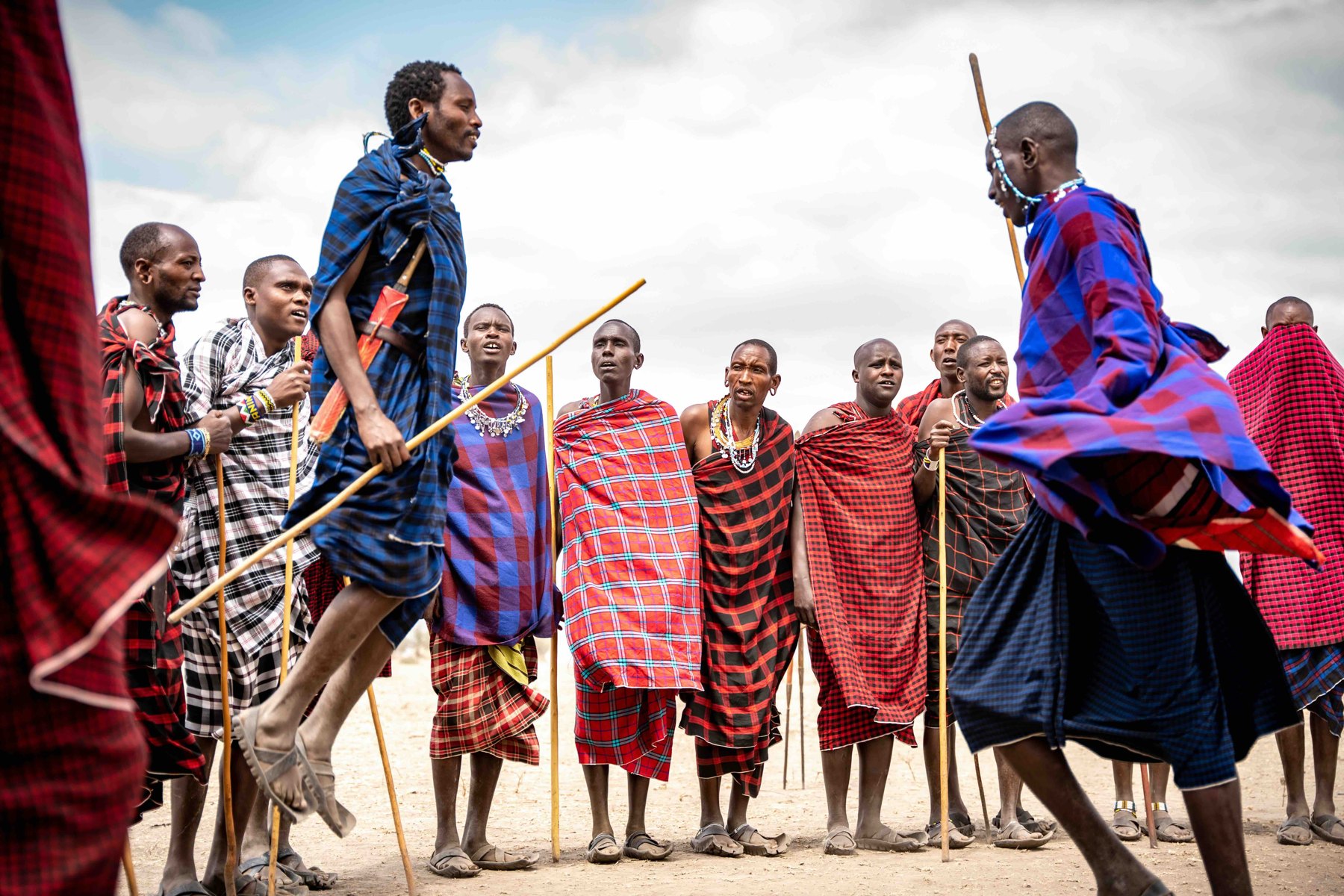
Two men are in the air. They wear checked shúkà, red going to blue, their backs straight and their heels tucked, off the ground. Behind them a line of others stands with thin staffs, watching. The sky is pale and empty behind them. There is dust. Beaded collars catch what light there is. This is the adumu, the jumping dance; I was there, and you were not, and that is the only reason you have my account of any of it.
Beneath the picture there is a box for the caption, and the box is empty.
No one has written the sentence yet. The men are still coming down. Whatever a stranger eventually believes about this exact instant — who these men are, what the leap was for, whether they rose for the elders or for the cameras — will not be settled by the picture, which cannot say, and not by the men, who will never see it. It will be settled by the sentence someone types into that empty box while they are still in the air. The frame is fixed forever. Its meaning is not. I write that.
Everywhere else in this craft, someone can check you. In that box, for the length of a stranger’s first glance, no one can.
The men jumping do not get a say. They will never see the caption. And I could type three different sentences under this one photograph, each of them defensible, each pointing a stranger’s belief in a different direction — a warrior’s rite of passage, young men competing, a dance staged for the cameras that came — and I cannot tell you with certainty which of the three this frame is. None of it will be decided by the men. None of it will be decided by the leap. It will be decided by whichever sentence I put in the box. That is not a confession of sloppiness. It is the point.
In 2015, World Press Photo took back a first prize, and the photograph had done nothing wrong. The camera was never the problem. The words were.
The most private power you have
There is a place in this craft where your power over another person is total and invisible, and it is not the shutter. It is the caption. Think of everything that normally holds you honest. The light does what it does whether you deserve it or not. The subject, standing in front of your lens, can turn, can refuse, can walk off. Someone else stood beside you and saw the same thing. But in the half-second of a stranger’s first glance, there is only your sentence and their belief, with nothing between the two. The person in the frame has no vote. The viewer has no other source. And the jury, the editor, the stranger takes your handful of words as the plain truth of the thing.
Roland Barthes gave this act its exact name sixty years ago. He said an image is polysemous — it carries a floating chain of possible meanings, and the reader is free, uneasily, to pick among them. The caption exists to end that freedom. Barthes called its function anchorage: the text is there to fix one reading and eliminate the others, to counter, in his phrase, “the terror of uncertain signs.” Read that again with the jumping men in front of you. The terror is the viewer’s — the discomfort of not knowing what they are looking at. And I resolve it for them. I decide which meaning they are allowed to keep. Most of us write it last, in a taxi, and call it paperwork.
The words tell the jury what they are looking at
I do not have to lie for this to work. A perfectly true caption is not a neutral one.
Psychologists have known since Tversky and Kahneman’s 1981 experiment that two logically identical descriptions of the same fact pull judgment in opposite directions. Describe a policy as saving two hundred lives and people play it safe; describe the same outcome, the same arithmetic, as four hundred lives lost, and they gamble. Nothing changed but the words, and the words chose what became visible. Susan Sontag put the photographer’s version of it plainly: pictures, she wrote, “wait to be explained or falsified by their captions.” Take the sentence away and the same frame stops accusing anyone of anything — a photograph, left to itself, will not tell you whether you are looking at a warning, a record, or a memorial.
So run the three captions past your own eye. A warrior’s rite of passage — and the leap reads as solemn, load-bearing, a threshold. Young men competing — and the same bodies turn playful, sporting, a Sunday. A dance for the cameras that came — and the third sentence plants a doubt the first two never raised; the same leap can now be read as performance. Same dust. Same collars. Same two men who have not yet landed. The reading followed the sentence, every time, and you are a careful reader who was warned it was coming.
That is the unsettling floor. “I didn’t lie” is not a defense, because the honest caption still chose what the stranger sees. There is no neutral sentence to fall back on — only the one that works for the picture and the one that works against it. And when I choose it at 11:52 on the night the portal closes, I am letting the least considered thing I wrote all month decide what my best work is about.
The caption is a rule, not a courtesy
Now the words stop being persuasion and become law.
At World Press Photo the caption is regulated. The entry rules require, verbatim, that “all entries must have accurate captions and descriptions, written in English.” It sits in the rulebook numbered alongside the bans on manipulation — not in a style guide, not in a tips-for-applicants sidebar. A rule. And they mean it in the most literal way available: after the jury has voted, but before any winner is announced, a fact-checking team goes through the captions line by line — whether the people named are in the frame, whether the event holds, whether it happened where and when the words claim. A name, a place, a date can sink an entry, however good the picture. The jury votes on the pictures; then the words are checked against the world, and it can lose.
That last check has teeth. Here is the 2015 revocation in full: World Press Photo took back Giovanni Troilo’s first prize in Contemporary Issues after it emerged that an image his caption placed in Charleroi had in fact been made in Molenbeek, a Brussels district roughly an hour away by road. The stated ground was blunt and procedural: the story did not comply with the entry rules, so the award had to come back. Note what did the damage. Not the photograph, unchanged before and after. The sentence. It said here; the picture had been made there; and the gap between the two unmade a season’s work.
Troilo’s own account was that the captions had been written under deadline pressure, in the rush before submission. Take that however you like — the prize stayed revoked regardless of anyone’s intent. But do not file it as his private failure. That is the standard workflow. The image gets the two hundred hours; the words get handed off in the last hour to whoever is closest to the keyboard. It cost Troilo a World Press Photo prize. It is also, exactly, my 11:52 — and yours. The care went to the picture, and the words are what broke the work.
Why you are the one person who cannot see it
If the sentence is this powerful, why does every experienced photographer keep under-writing it? Not laziness. A structural blindness, and it has a name.
Economists call it the curse of knowledge: the well-informed cannot fully un-know what they know when they judge what a stranger will understand. In a 1990 study, people were asked to tap out a famous tune on a table with a finger, then guess how many listeners would name it. They guessed about half. The real figure was closer to one in forty. The tapper hears the whole orchestra playing in their head. The listener hears knuckles on wood.
You are the tapper. You know these men are mid-adumu, you know what happened four seconds after the shutter. So a warrior’s rite of passage reads to you as full, even generous, because your own mind pours two hundred hours in behind it. The stranger gets the knuckles. And because you already know what the picture means, you are the last person who can judge whether your words carry that meaning across — you cannot un-know your way back into the stranger’s chair.
The thing your knowledge is quietly filling in is the men — who they are, why they are leaping, what the day was for. Your private certainty about them feels, to you, like it is on the page. It is not. It never left your head. And so who these men are, to a stranger, is not who you know them to be — it is whoever your unchecked sentence happened to make them. In 2013 a Magnum photographer’s project on his hometown named one subject a former Marine sniper. He had served in the Marines; he had not been a sniper. The series was framed around a crime-scarred district he did not live in, and he had in fact posed for the picture inside his own garage. No one meant him harm; the awards were even upheld. But the caption, not the man, authored who the stranger met — and it got him wrong. That is the whole danger in one case: the sentence speaks for the subject, to people who will never hear the subject’s own voice, and the subject never gets to answer.
Where it is decided
Most entries do not lose on a Troilo-scale breach. Most live or die in the middle of the pile, where a dozen strong pictures fight for three slots and the images are, honestly, close. That is exactly where jurors reach for the words.
Sit on that kind of panel and the rhythm is always the same: image first — until two images are equal, and then the room turns to the words. In a themed prize this is not even a tiebreaker; it is the event, because the work is being judged on how precisely it answers the theme, and the answer lives in the sentence. Photolucida’s Critical Mass makes this structural and is unusually honest about it. Per-image captions there are optional. A statement is required — 250 words, about the specific body of work. The pictures on the screen are small; the paragraph carries the weight. In their own framing, the statement is there so a viewer or juror can find a way in — an official admission that the paragraph tells the panel how to look. The W. Eugene Smith grant, for its part, weighs the applicant’s stated need: your case, in words, is a judged dimension of the award. At the strict end, the sentence is not attached to the work. It is part of the work being scored.
What this asks of your week
This is not a scolding. I am the man at 11:52 too.
Everything above is an argument that the caption is dangerous — a private, unanswerable act of power over people who cannot correct you. The reflex is to feel bad about it. Don’t. Turn it once more. Because the sentence holds that much power over people who never get to answer back, the hour you give it is not a chore — it is what earns you the pen, and the most respectful thing you can do for the work and for the men in the frame.
So spend it, this week, and spend it early. Some day soon you will nearly finish a picture you care about, and you will feel the caption pull toward the last small chore before the submit button. That pull is the curse of knowledge, and it feels like efficiency. Write the sentence days before the deadline, before the clock starts pressing. Then do the one thing your own knowledge makes impossible from the inside: hand the picture and the words to someone who was not there, and watch them misread it. Their misreading is not their failure — it is the precise shape of the gap between what you know and what your sentence actually says, and it is the one thing you were never going to see on your own. Then read the contest’s rules on captions the way you would read a contract, because at the strict end it is one: anything you assert should be something you can stand behind, and anything you arranged in the frame disclosed rather than quietly hoped past.
The men are still in the air. The box beneath them is still empty. The sentence is still mine to type, and yours, under your own picture, this week. Make it the true one — not because a fact-checker is coming, though one may be, but because it is the only sentence they will ever get, and they are trusting you for all of it.
The Sunday Submission is a column from WinPhoto. The rest of the time it reads photo-contest rulebooks and checks a photo and its caption against the part a machine can actually hold — names, dates, species, stated rules. It does not judge whether a photograph is good, or whether a caption is the true one; as the column argues, only someone who was there can do that.