This competition has closed. Its entry deadline has passed; this piece is kept for reference. For competitions open right now, see the summer deadline calendar → or browse what’s open today →.
A weekly editorial column. Each Sunday, one prestigious contest closing inside the next thirty days, read through the rubric the jury actually uses.
The Mangrove Photography Awards is run by a conservation nonprofit, not a publication. That single fact reshapes what wins.
Where commercial contests reward photographer voice — the working artist whose style the magazine wants on its cover — Mangrove rewards documented ecological relationship. The frames the jury pulls forward have field-time behind them. A named reserve. A documented species. A relationship between a human community and a specific mangrove forest that didn’t begin the week the photograph was shot.
The contest is free to enter. The grand prize is $1,000. There is no commercial advancement to gain. The reward for winning is what the photograph does in the world — appearing in conservation conferences, ocean-and-biodiversity press, MAP’s own educational materials. Photographers entering for résumé pad lose. Photographers entering because the work is already inside the brief tend to surface.
The contest, in numbers
| Field | Value |
|---|---|
| Cycle | Mangrove Photography Awards 2026 (11th season) |
| Total prize pool | USD 7,000 |
| Grand Prize (overall) | USD 1,000 |
| Category winners | $500 each (11 total) |
| Submission deadline | 1 June 2026 (8 days from publication) |
| Entry fee | Free |
| Eligibility | All experience levels, open internationally |
| Format | JPEG · min 2000 px long edge · captions required |
| Source | mangroveactionproject.org/mangrove-photography-awards |
The prize-to-fee ratio (infinite — there is no fee) is not the relevant economic frame. The cost is the time spent reading the brief carefully, picking the right frame from your archive, and writing a caption that actually documents what’s in the image. Roughly four hours of careful work per category you enter. That’s the trade.
The brief, in MAP’s own language
The Mangrove Action Project frames the contest as a conservation tool, not as art photography. Key positions from the rules:
“Open to photographers at all levels.”
“You must own the copyright to any image submitted.”
“AI-generated or computer-rendered photos are not allowed.”
Categories rotate around the mangrove ecosystem: wildlife, landscapes, communities living in or near mangroves, threats, and conservation success.
The phrase the conservation jury reads for, not stated directly but consistent across past Grand Prize selections: the photograph documents a real relationship to a specific mangrove ecosystem. Visiting-photographer frames where mangroves happen to be in the background lose. Frames where the mangrove is the subject AND the photographer has documented context (specific country, specific reserve, specific community, specific species, specific threat) win.
What the six categories tell us
The 2026 cycle has six categories. Read them carefully — the categories ARE the brief:
- Wildlife — animals within mangrove habitats. Birds, reptiles, crustaceans, marine life. Species-specific and ecologically grounded.
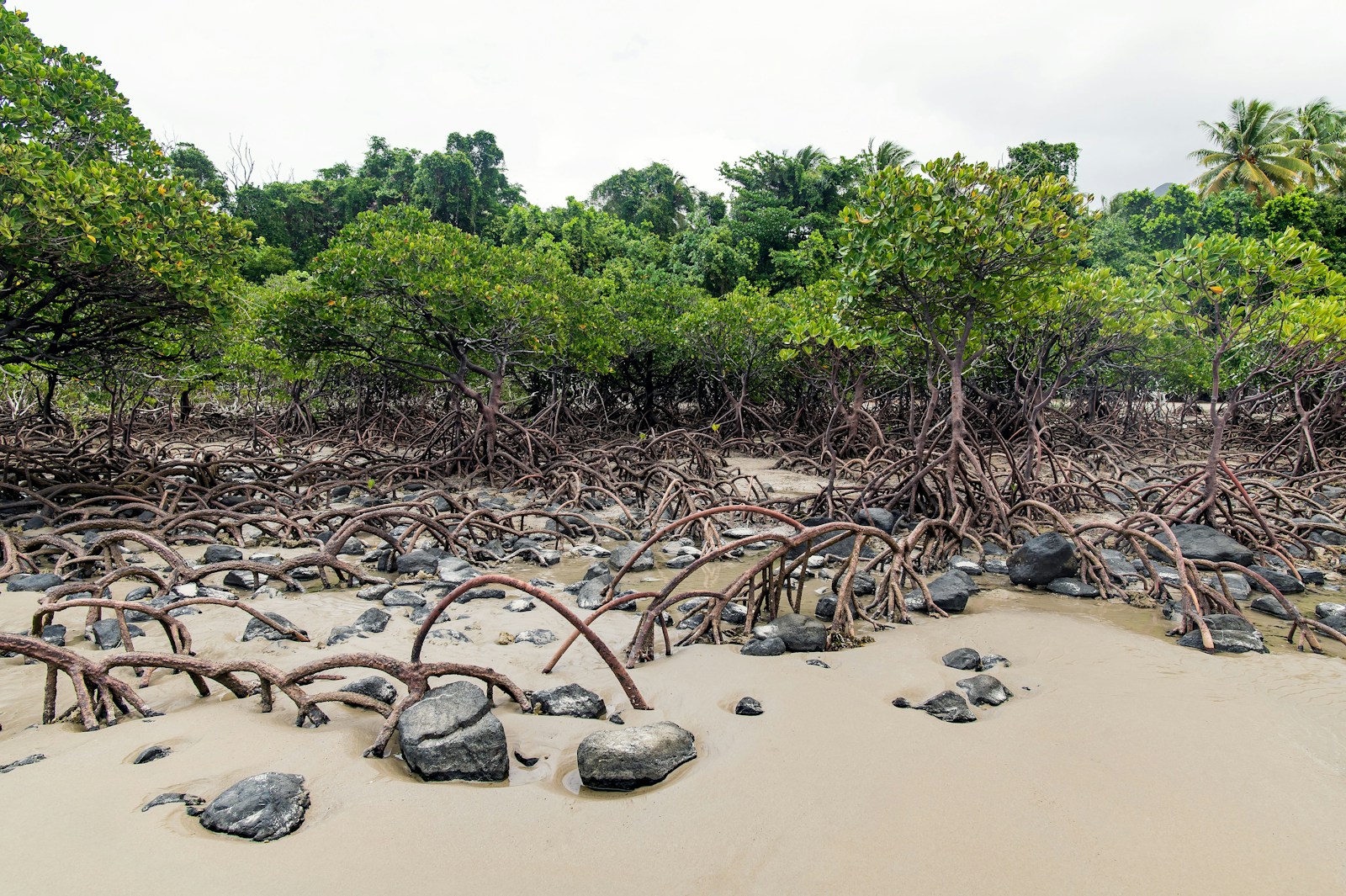
- Landscape — mangrove ecosystem landscapes. Roots, canopies, tidal zones, coastal forests at scene level.
- People — mangrove communities. Fishers, harvesters, conservation workers. People-in-mangrove-ecology frames.
- Underwater — below-water imagery. Submerged root systems, nursery habitats, marine species using mangroves as nursery or refuge.
- Threats — ecosystem threats. Deforestation, pollution, climate impacts, habitat loss documented honestly.
- Conservation Stories — portfolio category: six images showing a long-held commitment to mangrove conservation.
Every category names a relationship, not a subject. “People” is not portraiture; it’s mangrove communities. “Wildlife” is not generic animals; it’s animals within mangrove habitats. The category that most photographers miss is Conservation Stories — it’s the only portfolio category, requires six images that form a coherent multi-frame thesis, and rewards the photographer who’s been working a single project for years.
The authenticity policy, in MAP’s own language
The AI policy is short and absolute:
“AI-generated or computer-rendered photos are not allowed.”
Beyond AI generation, the jury reads for documentary integrity. Captive subjects, baited wildlife, staged conservation moments, and over-processed colour-saturation all score poorly. The contest’s framing is biological-fidelity: the photograph should document what was actually in front of the photographer in a real mangrove ecosystem.
If you compositied two frames in Lightroom to extend a horizon, you should not enter that frame here. If you used generative fill to remove a tourist from a background, that frame is not eligible. The jury is conservation scientists alongside documentary photographers; they read for evidence, not aesthetic.
A Strong Submit checklist for Mangrove 2026
Run your candidate frame against these seven questions. A “no” on any of items 1, 2, or 3 means the frame is a Weak match — submit it elsewhere.
- Is the mangrove ecosystem the subject of the photograph, or background? Subject wins. Background loses.
- Can you write a 50-word caption naming the specific country, specific site, and specific ecological context? If your caption is vague, the frame is vague.
- Did the moment occur as you shot it, or did you stage or composite it? Documentary integrity is non-negotiable.
- Is the species (if wildlife) or community (if people) identifiable to a reader who knows the region? Generic loses.
- Does the post-processing serve the document, or does it serve the aesthetic? Heavy colour grading reads as photographer-imposing-self.
- Does your portfolio (if Conservation Stories) show six images from a single sustained project? Six greatest hits from six different trips lose. Six frames from one working relationship win.
- Have you read this brief AT LEAST TWICE, with a highlighter, marking the nouns? If you haven’t, you haven’t read it.
The seven-question test takes ten minutes per frame. The cost of skipping it is the slot — Mangrove is free to enter, but each entry occupies one of your year’s attention windows, and the jury reads the wrong frame in three seconds.
The rubric in operation: three reads
Three hypothetical photographer scenarios. Each describes a real submission pattern. Each gets the engine’s four-tier verdict.
Photographer A. A wildlife photographer in Bangladesh shoots Sundarbans tigers, with extended field-time documenting the tiger-mangrove-fishing-community triangle. Submits a frame of a tigress walking a tidal channel at dawn with a fishing boat just visible in the deep background. Caption names the reserve, the season, the photographer’s three-year project documenting this specific area.
Verdict: Strong submit. The tiger is the visual subject; the mangrove is the ecological subject. The caption documents the relationship. The background fishing boat extends the brief into the “People” register without splitting attention. The three-year project signal tells the jury this isn’t visit-photography. The technical execution can be ordinary — the jury reads context.
Photographer B. A travel photographer on a one-week trip to Florida’s Ten Thousand Islands shoots a beautifully composed sunrise frame of mangrove silhouettes against pink water. Strong technical work. Caption reads: “Sunrise in the Everglades, Florida — magical morning at the mangroves.”
Verdict: Maybe. The composition is competent. The colour is real. But the photograph reads as a postcard from a tourist who happened to bring a tripod. The caption confirms it — no specific species, no specific site within the Everglades (which is enormous), no documented relationship. The jury will pull it from the long list and move on. The frame might win at a different contest; here it’s a Maybe at best, a Weak match honestly.
Photographer C. A conservation photographer in the Philippines shoots a documentary frame of a small fishing community planting mangrove seedlings as part of a reforestation program. Frame shows three women, knee-deep in mud, hands holding seedlings. Caption names the village, the NGO running the program, the photographer’s documented two-year relationship with the community.
Verdict: Strong submit, in People category specifically. The frame is exactly what Mangrove rewards — humans + mangroves + documented conservation action + cultural specificity. Could also enter the same project as part of Conservation Stories if there are five more frames from the same body of work.
The three reads share a pattern: the verdict track is set by context more than craft.
The week’s strategy
If you’re entering Mangrove 2026, here is the week’s order of operations:
Today (Sunday). Read the brief and category descriptions twice. Identify which category your strongest frame fits. If your archive has no mangrove-specific work, skip this cycle honestly; the seven-question test will catch it.
Monday. Pull every candidate frame from your archive. Run each through the seven-question test. Most will fail at question 1 or 2 — don’t argue with the verdict, just discard.
Tuesday-Wednesday. Write captions for the survivors. The caption is half the submission. A great frame with a generic caption is a Maybe.
Thursday-Friday. Final selection — one frame per category. If you have a six-frame coherent project from one location/community, submit Conservation Stories instead.
Saturday. Hold the submissions overnight. Re-read tomorrow before submitting.
Sunday 1 June. Submit by 23:59 UTC. The contest closes that day.
If at any step you find yourself arguing with the seven-question test — “but this frame should count even though…” — that’s the jury’s verdict, not yours. The Maybe register is honest. Save the work for a contest with a better brief-fit.
Run a frame against the rubric
Drop a frame on /analyze and the engine reads it against Mangrove 2026’s brief in about thirty seconds. The verdict comes back in the same four tiers used here — Strong submit / Submit / Maybe / Weak match — with the specific craft reasoning. If the frame doesn’t fit Mangrove, the engine surfaces the contest where it does fit (often Ocean Photographer of the Year, Nature Photographer of the Year, or World Nature Photography Awards — all open right now).
The engine respects the same brief-as-constraint logic this column reads by. It will not tell you a beautiful mangrove postcard is a Strong submit at Mangrove. That’s the engine’s working position, and this column’s editorial position.
Next Sunday, and the column shape
Next Sunday’s Issue № 03 will read the LensCulture Critics’ Choice 2026 — the moderate-fee portfolio prize closing 15 June. A different jury voice: gallery editors and curators, not conservation scientists. Different craft register: portfolio coherence over single-frame strength. Different verdict pattern: the photographer who has been working one editorial thesis for years wins; the photographer with five strong unrelated frames doesn’t.
The column reads one contest per week, every Sunday, through the rubric the jury actually uses — not the rubric the marketing copy implies.
— The Critic